Materials
& methods.
What we build with, why we choose it, and the construction details that decide whether something lasts eight years or thirty.
Most quotes hide the parts that matter.
Two decks can look identical on the day they are finished and be twenty years apart in lifespan. The difference is underneath — fasteners, flashing, footing depth, and how water gets out.
We would rather explain those choices than have you compare our number against somebody else's without knowing what is in each. Everything below is what we actually specify, and why. If you want a cheaper version of any of it, ask — there is usually an honest way to save money, and there is usually a way that just moves the cost to your future self.
Ask any contractor these three questions
How deep are the footings? What fasteners are you using, and are they rated for this lumber? How does water get out of the assembly? The answers tell you almost everything.
Wood we build with
There is no best wood, only the right one for the job. Hardness matters on a counter; stability matters on a table; colour matters everywhere.
| Species | Typical use | Why we pick it | Hardness |
|---|---|---|---|
| Hard maple | Butcher block, counters, tables | Very hard, tight closed grain, nearly white. The traditional choice for a work surface because it dents rather than splinters and sands back to new. | Hard |
| Black walnut | Tables, mantels, feature pieces | Dark chocolate heartwood that needs no stain. Softer than maple and pricier, but nothing else looks like it. Lightens slightly with sun. | Medium |
| White oak | Floors, exterior trim, furniture | Closed cellular structure makes it genuinely rot-resistant — the reason it was used for boats and barrels. Takes a fumed or quartersawn finish beautifully. | Hard |
| Red oak | Trim, floors, cabinetry | The workhorse of New England houses. Open grain, warm pink tone, and it matches the trim already in most homes here. | Hard |
| Cherry | Cabinetry, built-ins, furniture | Machines like a dream and darkens to a deep red-brown over a few years. Plan for that colour shift rather than fighting it. | Medium |
| Ash | Tables, shelving, bench tops | Oak-like grain, lighter colour, excellent shock resistance. Often better value than oak for the same look. | Hard |
| Poplar | Painted trim, built-ins, jigs | Stable, inexpensive, and takes paint flawlessly. Wrong for a clear finish, ideal under it. | Soft |
| Eastern pine | Shelving, rustic builds, platforms | Light, cheap, locally milled, and it dents — which reads as character on a farmhouse piece and as damage on a kitchen island. | Soft |
Wood moves. Always.
Every board expands and contracts across its width with humidity — a 24" wide panel can move nearly a quarter inch between a New England August and February. Good joinery allows for it: breadboard ends that float, tabletop fasteners that slide, panels that sit loose in their frames. Furniture that cracks in its first winter was built by someone who ignored this.
Reclaimed and sentimental wood
A tree that came down in your yard, barn boards from a family property, an old workbench top. We work with all of it. Two honest warnings: reclaimed lumber hides nails and grit that destroy planer knives, so milling costs more, and it needs to acclimate indoors for weeks before it is stable enough to build with. Bring it early.
Decking compared, honestly
Material cost is the smallest part of this decision. Weekends spent sanding and sealing are the real price of a cheap deck.
| Material | Cost | Realistic life | What you are signing up for |
|---|---|---|---|
| Pressure-treated pine | $ | 10–15 yrs | Cheapest to build. Needs cleaning and sealing every 2–3 years or it greys, checks and cups. Fine when budget rules. |
| Cedar | $$ | 15–20 yrs | Naturally rot-resistant, light, and smells wonderful. Soft, so it scratches. Still needs finish to hold colour. |
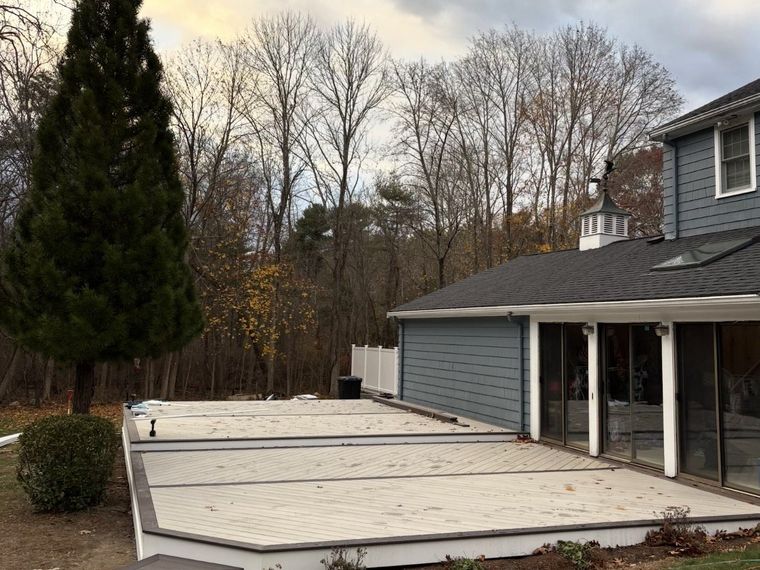
| Composite (capped) | $$$ | 25–30 yrs | Wood flour and plastic with a bonded shell. No sanding, no staining, hidden fasteners. Gets hot in direct sun and cannot be refinished. |
| PVC | $$$$ | 30+ yrs | All polymer, no organic content, so nothing to rot or feed mould. Lightest and coolest underfoot of the synthetics. Highest material cost. |
Footings
New Hampshire frost line runs deep. Footings that stop short of it get lifted by frost heave every winter until the deck racks and the stairs no longer meet the landing. We dig below frost depth, every time, and it is on the quote so you can check that the other guy did too.
Ledger & flashing
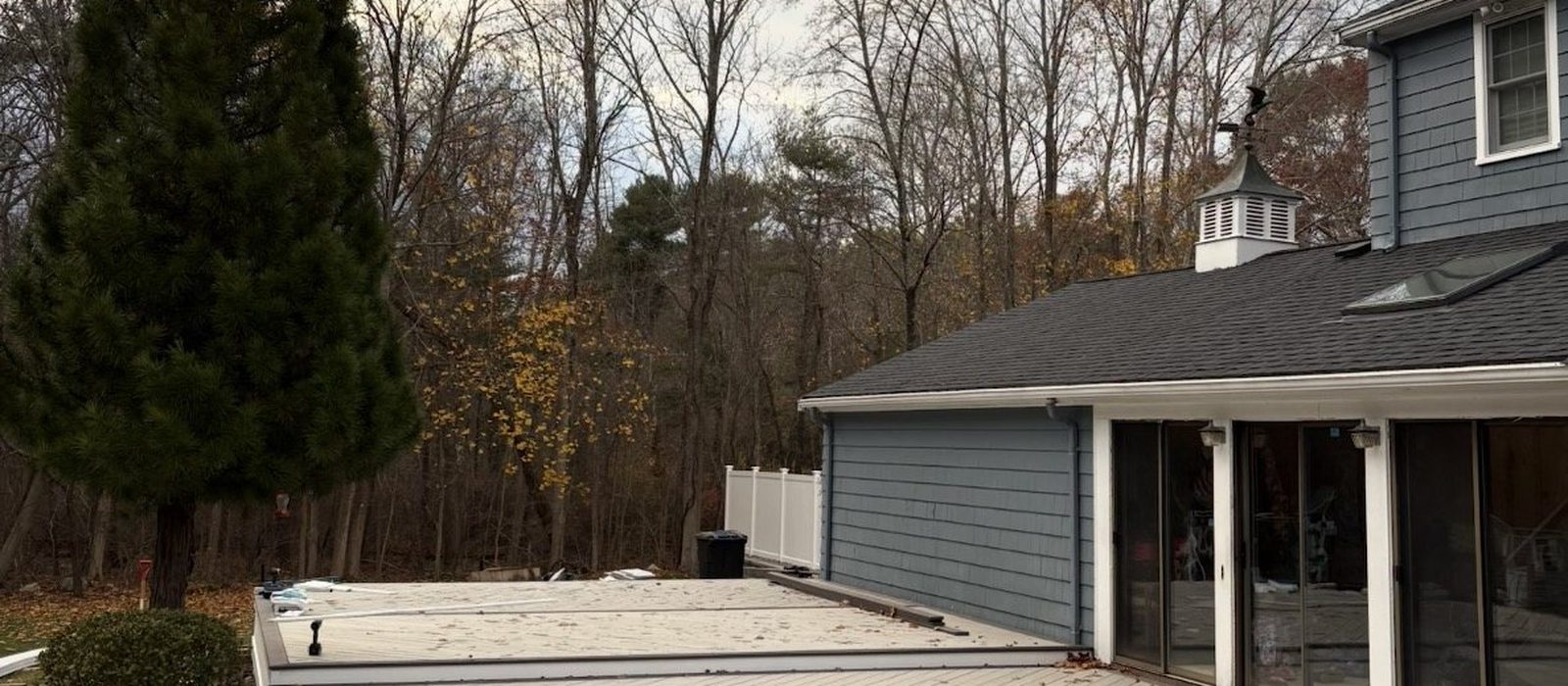
Where the deck meets the house is where decks fail and where people get hurt. It needs structural fasteners into the rim joist — not nails, not lags into siding — plus flashing that sheds water out and away. A ledger that traps water rots the house framing, not just the deck.
Fasteners
Modern pressure-treated lumber is corrosive to plain steel and to standard aluminium. It needs hot-dip galvanised or stainless. Near the coast we go stainless. Using the wrong screw is invisible on day one and structural by year seven.
Things you will never see, that decide everything.
Manage water before you frame
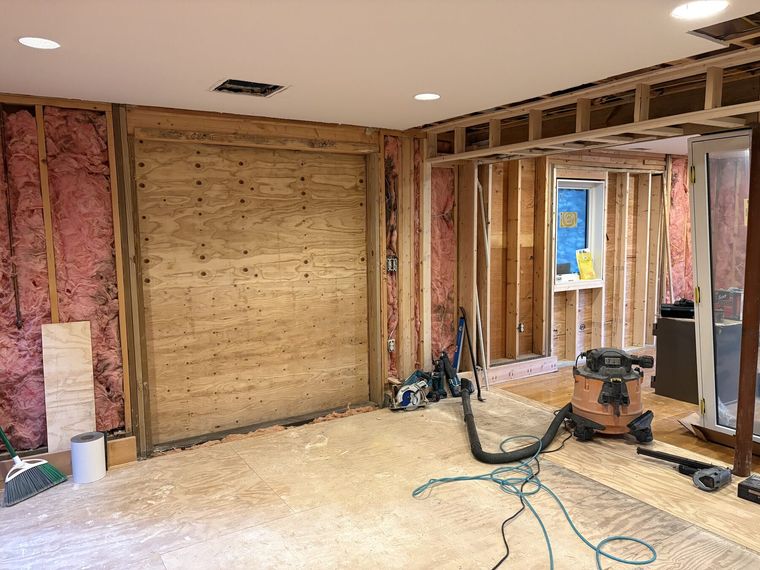
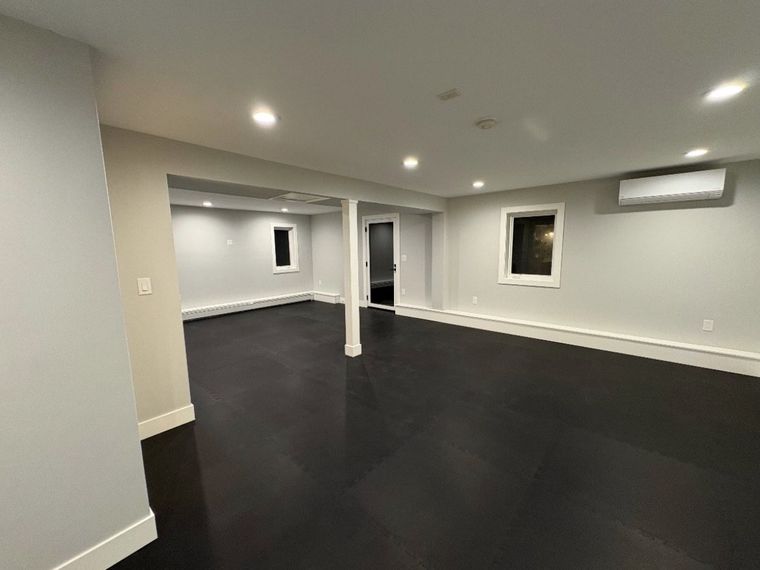
Finishing a basement that takes water is money set on fire. We look at grading, gutters and the perimeter first. Then framing gets held off the concrete, insulation is chosen so the assembly can dry, and we leave real access to shutoffs, cleanouts and the panel — because you will need them, and cutting a hole in new drywall to find them is miserable.
Waterproofing is not tile
Tile is not waterproof and neither is grout. What keeps water out of your floor joists is the membrane behind and beneath it, the slope of the pan, and the sealed corners and penetrations. This is the single most common place we find previous work done wrong, and it is always found after the ceiling below stains.
Removing a wall
Before anything is cut we establish whether the wall carries load, what it carries, and where that load goes once the wall is gone. That means a properly sized header, real bearing at each end, and a load path continuing down to the foundation. Temporary shoring holds the structure while we work. Where it is warranted we bring in an engineer — that cost is trivial next to a sagging floor.
Why good trim looks good
Tight miters come from a sharp blade, a tuned saw, and cutting to the actual angle rather than assuming 45 — corners in old houses are never square. Nails go where the filler will not read. Long runs get scarf joints instead of butt joints. Everything is back-cut to sit flat on walls that are not flat. It is slow, and it is the entire difference between finished and merely installed.
How pieces are actually held together
Furniture fails at its joints. These are the ones we use, roughly weakest to strongest:
- Pocket screws — fast and strong enough for hidden face frames and shop fixtures. Not for anything that shows or racks.
- Dowels & biscuits — mainly alignment. They help a glue joint stay flat; they add little strength on their own.
- Dominoes / floating tenons — a loose tenon in two mortises. Most of the strength of a real mortise and tenon, a fraction of the time.
- Mortise & tenon — the standard for table and chair legs for several centuries. Enormous glue surface and mechanical interlock.
- Dovetails — mechanically locked in one direction, so drawer fronts cannot pull off. Slow, and the reason a good drawer feels like a good drawer.
Glue-ups matter as much as the joint. Modern PVA glue is stronger than the wood around it when the joint is tight, clamped evenly, and given real cure time. Rushing a glue-up is how a joint fails in year three.
What goes on top
- Hardwax oil — soaks in, looks and feels like bare wood, spot-repairable. Our default for tables.
- Mineral oil & wax — food-safe, for butcher block. Re-oil monthly at first, then when it looks thirsty.
- Waterborne poly — tough, clear, low odour, fast. Best for floors and hard-use surfaces.
- Conversion varnish — the durable catalysed finish used on cabinetry. Sprayed in the shop, not on site.
- Exterior stain — penetrating, not film-forming. Film finishes peel outdoors; penetrating stains fade and recoat cleanly.
Acclimation is not optional
Flooring and hardwood sit in the room they will live in, at normal temperature and humidity, for days before installation. Skip it and you get gaps in February or buckling in August. It is the most commonly skipped step in the trade.
How a joint decides whether furniture survives
All of the above, on real jobs


Want the version of this for your project?
Tell us what you are building and we will walk you through the choices — materials, cost, and what each one buys you.